

See the playlist, film clip, visual fragments and the longer essay behind this example.
Pages blur into notes.
You forget what you came to ask.
It starts innocently. You are deep in preparation and tell yourself:
Just one more page.
Just one more file.
Just one more testimony.
But »one more« turns into hours. Then nights. Then a strange state where you cannot stop scrolling, cannot stop reading and cannot put the material down.
At some point, you are no longer reading to prepare.
You are reading because you cannot let go.
That is not immersion. That is drowning.
Why It Happens
When you research material shaped by grief, violence or traumatic events, your body can confuse exposure with depth.
You think:
If I keep reading, I will finally understand.
But what may actually be happening is this:
you are flooding your nervous system with more sorrow than it can hold.
You begin to mistake the quantity of what you have absorbed for the quality of your preparation.
And the archive never ends.
If you measure yourself by completeness, you will never stop.
Spotting When You Are Drowning
⬜ Do I keep saying »just one more« even when I am exhausted?
⬜ Have I stopped turning what I read into creative choices?
⬜ Am I losing sleep, haunted instead of inspired?
⬜ Do I feel as if I will never know enough to start?
⬜ Am I mistaking grief saturation for preparation?
The Cost Of Endless Reading
Paralysis
You delay making creative choices because you tell yourself you do not know enough yet.
Emotional Drain
You carry grief that is not yours, with no outlet.
Identity Blur
The more you read, the less clearly you know where you stop and the role begins.
Burnout
Instead of grounding you, history leaves you brittle.
Example: Berlin, 1945
A nightclub, just after the fraternisation ban ended.
A German woman steps onto the dance floor with a British soldier.
She does not know whether the man holding her might have killed her father, her brother or the boy from the next street.
And for one night, she decides not to ask.
To prepare, the actress had done the serious work.
She had read diaries.
Denazification records.
Postwar letters between mothers and daughters.
Each page carried guilt.
The fear of being seen with someone who had been the enemy only yesterday.
The fear of neighbours whispering.
The fear of a mother asking:
How could you?
But beneath the shame ran another truth:
I am still alive.
I am young.
I want one night where I do not have to think.
Soon, the research became too heavy.
Love turned into evidence.
Empathy turned into exhaustion.
Preparation turned into drowning.
So we stopped.
Not because she had not worked hard enough.
Because she already had what she needed.
We kept three fragments:
1. A playlist from the time
Light-hearted jazz and dance tunes drifting from smoky bars.
2. A handwritten invitation to a dance
A small trace of longing, risk and ordinary human hunger for life.
3. A short film clip
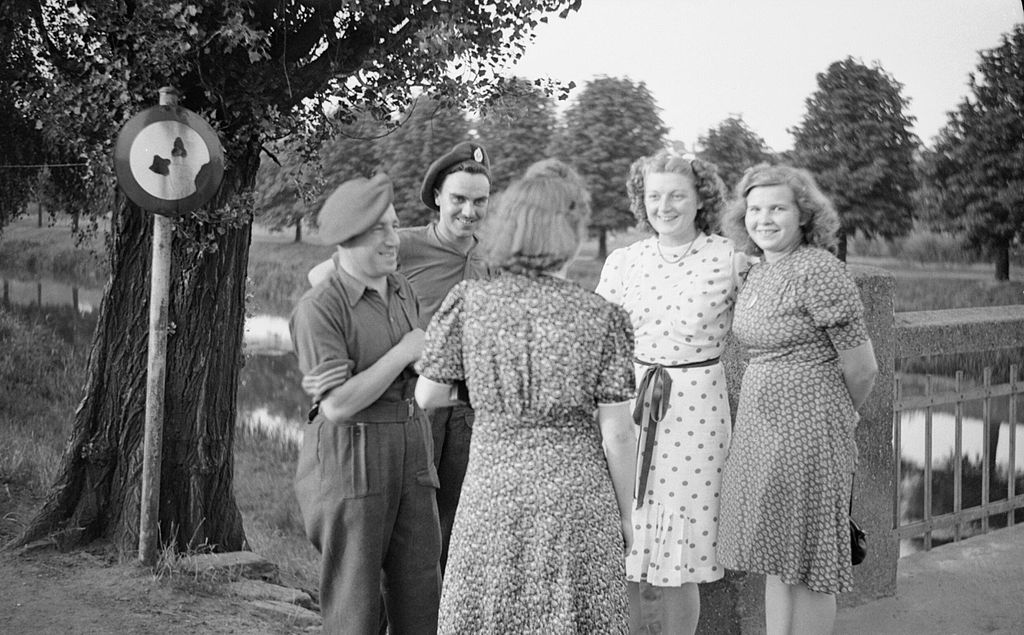
British and Russian soldiers swaying with German girls, beer glasses in hand, as if the war had not just happened.
Between those three fragments flickered the real contradiction of the scene:
guilt and joy
shame and desire
grief and the reckless relief of being alive
That was enough.
Not the whole war.
Not another week of reading.
Not every possible source.
Three fragments that let the scene breathe.
Checklist: Learning To Protect Yourself
1. Start With Structure
Containment before contact.
✅ Limit your sources. Choose 3–5 key documents, testimonies or objects.
✅ Set a boundary. Use a timer. Sixty minutes, then stop.
✅ Do not chase infinity. The archive will always offer one more door.
2. Transform What You Take In
Turn material into art, not storage.
✅ Translate immediately. Act out a moment, sketch a scene, write a reflection or record a voice note.
✅ Ask: What does this change in the scene?
✅ If it does not change breath, gesture, silence, rhythm or choice, it may be interesting, but it may not yet be useful.
3. Balance The Heavy With The Ordinary
Do not let grief become the only truth.
✅ Pair traumatic sources with neutral ones.
✅ Look for shopping lists, invitations, letters, jokes, music, everyday objects and small signs of pleasure.
✅ Remember: people still lived, loved, danced, laughed, wanted and reached for one more ordinary night.
4. Seek Perspective
Sometimes you need someone else to say:
Enough.
✅ Ask a historical consultant, dramaturg, director, peer or trusted reader to help you stop.
✅ Let someone help you choose what the role can actually hold.
✅ Remember that restraint is not laziness. It is part of the craft.
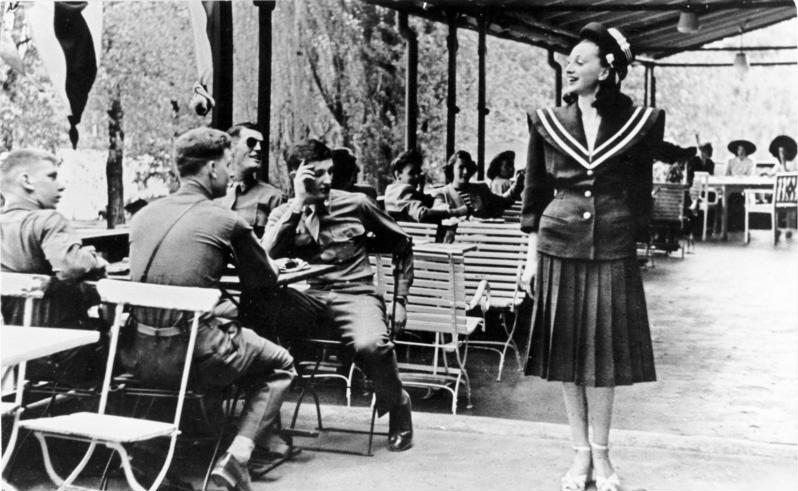
Berlin 1945/46: Source Trail For This Example
Visual Fragment: Postwar Dance Image Video
[Click here to view the dance video]
Playlist / Music
[Click here to open a 1946s Spotify playlist]
[Get an Amazon 1946s “Schlager” playlist here]
[And here’s a 1946s Youtube Playlist which is free]
Visual Fragment 1: Dance Invitation
[As I can’t link to the original dance invitation, see a different ticket here how improvised things were right after WW2: see it here]
What do we see in the dance video? »Various shots of couples dancing in a nightclub« reads the explanation. The decriptions adds:
- »Some of the men are in uniform
- seems to be all nationalities(!)
- the women are in civilian clothing
- a waitress walks by with trays of drinks
- a female Russian soldier pushes past the couples on the dance floor
- Could be the end of the fraternisation ban.«
Let’s assume that this is the end of the ban on fraternisation: Before, it was forbidden to even talk to foreign soldiers. You could not meet them, you could not have a relationship with them. The German government wanted to prevent the German people from hearing other points of view, which would have tainted the picture they were trying to paint of a superior German race. They also wanted to prevent espionage. —
This ban on contact would have been lifted. Couples who had to meet in secret would now be able to meet officially. For the first time in over 5 years, young German women would have the chance to meet British men. And the British soldiers would have had a bit more freedom of movement, and not just between soldiers.
When you watch the original footage again, pay attention to the small details.
The following details were very special in the days of 1945. The value of these things felt so much higher than it does today.
- Cigarettes — They were almost a »secret currency« in those post-war days.
- Alcohol — The waitresses bring trays and trays of glasses full of drinks.
- Jazz music — Try to retrace how the German girl must feel listening to jazz music, which had been strictly forbidden in Germany during the Nazi era. Young people who listened to or played jazz were taken to prison, work camps or even concentration camps(!). But now, all of a sudden, it’s OK to listen to this lively, upbeat jazz music again.
- Uniforms vs. civilian clothes — Try to understand how you feel as a German woman who has been taught for years that British, American and Russian soldiers are their worst enemies, and yet you find yourself dancing in the middle of a crowd of German women, dancing with »the enemy«. Imagine that these foreign soldiers might potentially have shot one of their fathers, brothers or friends in combat. And now everyone is here together, dancing.
While creating a general »feel« for the situation, music is crucial. Many of my clients love playlists to help them get into the headspace of a particular period, so check out this one: Music from the year 1945 / Die Schlager des Jahres 1945 If you scroll down a bit, there’s a playlist that you can listen to for free. You will recognise that there are a bunch of German songs. But there are also many English and American songs on this playlist.
Over to you: Listen to 3 songs — whether English or German
If you have chosen German songs, look up the lyrics by doing a quick online search. Use Google Translate to get an idea of what the lyrics are about. You will notice that most of the lyrics are happy and positive, and many of them are about first love. Other songs are old soldier songs, like the song »Lili Marlene«, which you can find as an English (!) version on the playlist. Perhaps an idea for a scene where both he and she know the words, and each of them can sing along in their own language? If you prepare to play a soldier after WW2, try this. Try to embody their feelings as they listen to the music — especially after the atrocities of war, and now facing the daily hardships of post-war life. Let them enjoy their new-found freedom to the fullest.
Don’t forget: The post-war days of the 1945s were filled with uncertainty.
As a German civilian, you didn’t know where your next meal was coming from.
You would no longer have a government to look after you.
You would hear terrible stories about soldiers using their position to abuse or hurt local women.
You might have experienced violence yourself; there would be no police to protect you.
You wouldn’t have heard from relatives in other towns because the postal and telephone services were down.
You’d have no money and would have to barter for things.
You would stand in line for hours or try to buy food on the black market, which was notoriously shady.
You probably wouldn’t have heard from your father, brother, boyfriend or fiancé who was at the front in Russia, Italy or Greece, because the military mail service wasn’t working. Were they dead? Wounded? Prisoners of War in Russia? You just didn’t know.

Final Thought For Actors
Research can open the role.
But if you let it flood you, it can take the role away from you.
You do not need to carry everything.
You need to know when to stop, choose the fragments that matter and let the scene breathe.