»The Memory Scar« is being reshaped into a deeper private framework. For now, ↓ start with the free actor checklist. ↓
For actors preparing historical or biopic roles — whether it’s your first or your next.
You’ve just been cast in a historical film or biopic — maybe even your first.
The panic hits quickly: everyone tells you to »do research.«
But all you’ve been handed are timelines, PDFs, and Wikipedia summaries.
None of that tells you how the past is supposed to feel.
You know you can’t guess your way into a real person’s emotional world.
And historical roles come with expectations — from audiences, directors, critics, sometimes even family members of the person portrayed.
You don’t need more exposition.
You need a way in.
Enter: The Memory Scar. A free 6-day email rehearsal built for actors under pressure.
Across six concise lessons, you learn to work from one historical photograph, taken in 1944, and peel back its emotional layers:
- your instinct
- the evidence
- one emotional scar
- one contradiction
- one silent memory
This isn’t method acting.
It’s a small, rigorous entry point into the interior life of someone from the past — grounded in real historical sources, not imagination. And if you ever want personal support, I’ll show you the ways you can work with me 1:1.
▶ Enter Your Email Here To Get It
By the end of the week, you will understand:
- the difference between a wound and a scar,
- how emotional residue hides inside historical material,
- how to read a photo like both an actor and a historian,
- and how to carry one subtle, accurate emotional cue into your next rehearsal.
Not full preparation — just the first solid foothold you need to begin.
Even experienced actors use The Memory Scar to sharpen the emotional precision of a historical role — the work is simple enough for first-timers, and exacting enough for actors who’ve carried these roles for years.
For writers, it offers the same precision: a way to build historical characters from the inside out, grounded in evidence rather than guesswork.
This technique was developed by me: I am Dr. Barbara, a German historian who has worked on more than 130 historical novels, historical exhibitions and film projects — specialising in helping you understand the past through the traces it left behind. But here, the scope is intentionally narrow.
One photo. One scar. One way into the past.
No pressure.
No production details required.
Just you, one image, and a quiet beginning.
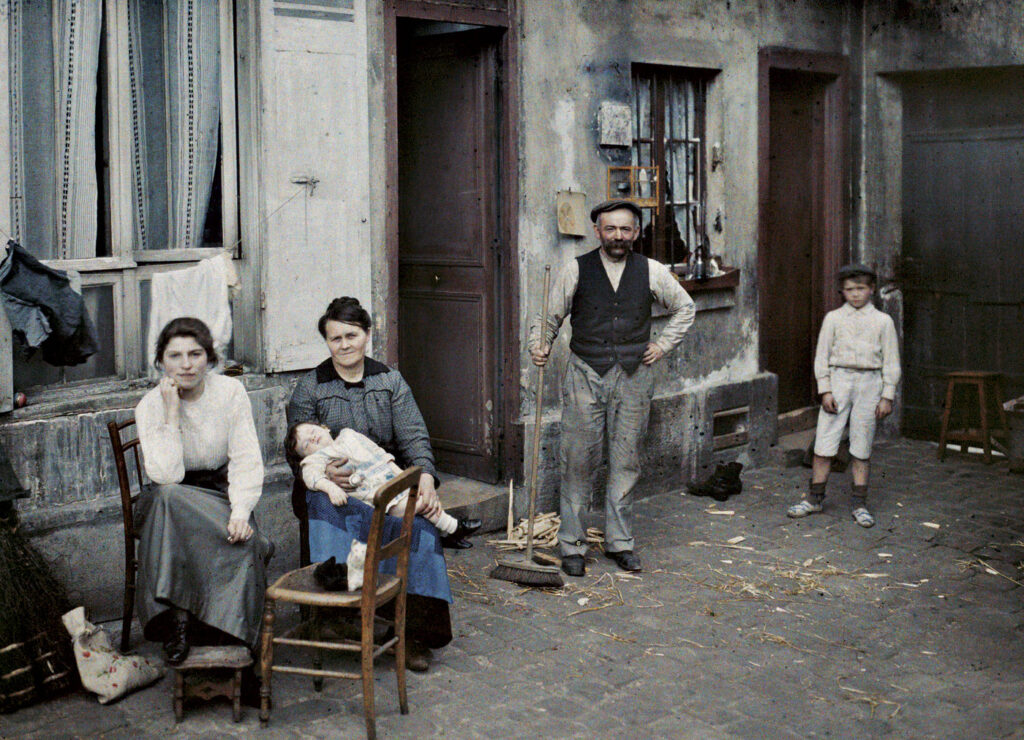
Stéphane Passet: A family in the rue du Pot de fer, Paris, France. Autochrome from Albert Kahn’s Archives de la planète, 24 juin 1914. Public Domain.